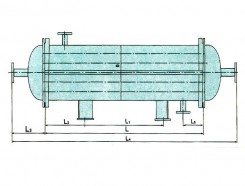
In today's rapidly developing industrial field, the performance of heat exchangers is directly related to production efficiency and energy consumption. As an important component of the heat exchange field, the improvement of heat transfer efficiency of stainless steel and carbon steel tube heat exchangers has always been a focus of industry attention. Recently, according to the latest report, the heat transfer efficiency of stainless steel and carbon steel tube heat exchangers has been significantly improved under the dual promotion of technological innovation and material optimization, bringing more efficient and energy-saving solutions to industrial production.
Stainless steel heat exchangers are widely used in multiple industries due to their excellent corrosion resistance and long lifespan. Structurally, stainless steel heat exchangers often adopt finned tube designs to improve heat transfer efficiency by increasing the heat transfer area. Experimental data shows that under ideal operating conditions, the heat transfer efficiency of stainless steel heat exchangers can reach or even exceed 90%, and some high-efficiency designs can even approach the theoretical limit of 100%. However, the heat transfer efficiency in actual operation is affected by various factors, such as the physical properties of the fluid, flow rate, pressure, and the specific structure of the heat exchanger.

In order to further improve the heat transfer efficiency of stainless steel heat exchangers, manufacturers will adopt advanced technologies and processes. For example, by adjusting parameters such as fin height, spacing, and thickness, as well as adopting advanced fluid dynamics design and multi-stage heat transfer technology, energy loss can be effectively reduced and overall energy efficiency can be improved.
It is worth noting that the corrosion resistance of carbon steel tube heat exchangers is relatively poor compared to stainless steel, so additional anti-corrosion measures need to be taken when used in highly corrosive media. In addition, the lifespan of carbon steel tube heat exchangers is relatively short, generally over 8 years, but the specific lifespan is also affected by factors such as medium properties, operating conditions, and maintenance.
 Address:Room 1202, Detaitang Building, No. 118 Huaguang Road, Zhangdian District, Zibo, Shandong
 WhatsApp:+8613386433135
 Tel: +8613386433135