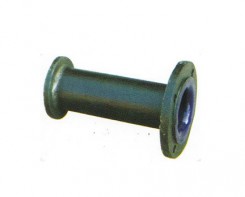
In industrial production, glass lined pipe fittings are highly favored due to their excellent corrosion resistance. These pipe fittings are widely used in various fields such as chemical, pharmaceutical, and food industries, providing reliable guarantees for the transmission of various fluid media. So, how are glass lined pipe fittings made? This article will provide you with a detailed explanation of its production process.
The production of glass lined pipe fittings first requires the preparation of a metal blank. This step usually involves processes such as smelting, rolling, forming, and heat treatment of high-quality enamel specific steel. In addition to general flame automatic cutting machines and automatic welding machines used for metal processing, there are also specialized machinery for billet making such as shearing machines and coiling machines. When making steel plates for industrial enamel equipment, forging and gas (electric) welding are generally used for forming. Traditional enamel blank making involves cutting, stamping, and welding on several machine tools.

Before coating, the surface of the billet must be cleaned to eliminate grease, dirt, rust, and internal stress formed during processing. The surface cleanliness of industrial enamel equipment steel plate blanks is often achieved through a combination of high-temperature oil burning and sandblasting methods.
1. Degreasing method: used to remove grease and other dirt from the surface of the body. The degreasing method for industrial enamel equipment is mainly the oil burning method, which involves burning the body at a certain temperature to remove grease.2. Sandblasting method: Compressed air is used to spray abrasives (such as silicon sand, steel balls, and other natural or artificial abrasives) onto the surface of the calcined billet to remove rust, oxide scale, and harmful substances adhering to the billet.
In the enamel coating process, it generally involves processes such as enamel coating, firing, enamel coating, and firing. For products coated with wet enamel, the glaze needs to be sprayed and brushed 6 to 7 times to achieve the desired thickness.
After the coating is completed, the product blank needs to be dried. The blank of products coated with wet coating must be dried before firing. Drying is the process of removing moisture from the glaze slurry coated on the blank using a dry and circulating hot gas. This not only enhances the strength of the glaze layer before firing and its bonding with the blank, but also prevents rapid evaporation of moisture during firing, which can cause cracking and bubbling of the glaze surface. In enamel production, waste heat from exhaust gas and waste heat from firing kilns are usually used for drying, and electric heating or electric far-infrared radiation heating is also used for drying. Drying is carried out in a drying room or on a drying bed.
The finished product blank coated with enamel needs to be fired to melt the enamel particles, so that the enamel can firmly bond with the blank. Enamel firing is carried out in a firing kiln, and to avoid contamination of the product by harmful gases and dust in direct flames, a flameproof firing chamber is usually used. There are various types of enamel firing kilns, such as intermittent firing kilns and continuous firing kilns. After firing, the product needs to be naturally cooled indoors.
 Address:Room 1202, Detaitang Building, No. 118 Huaguang Road, Zhangdian District, Zibo, Shandong
 WhatsApp:+8613386433135
 Tel: +8613386433135